
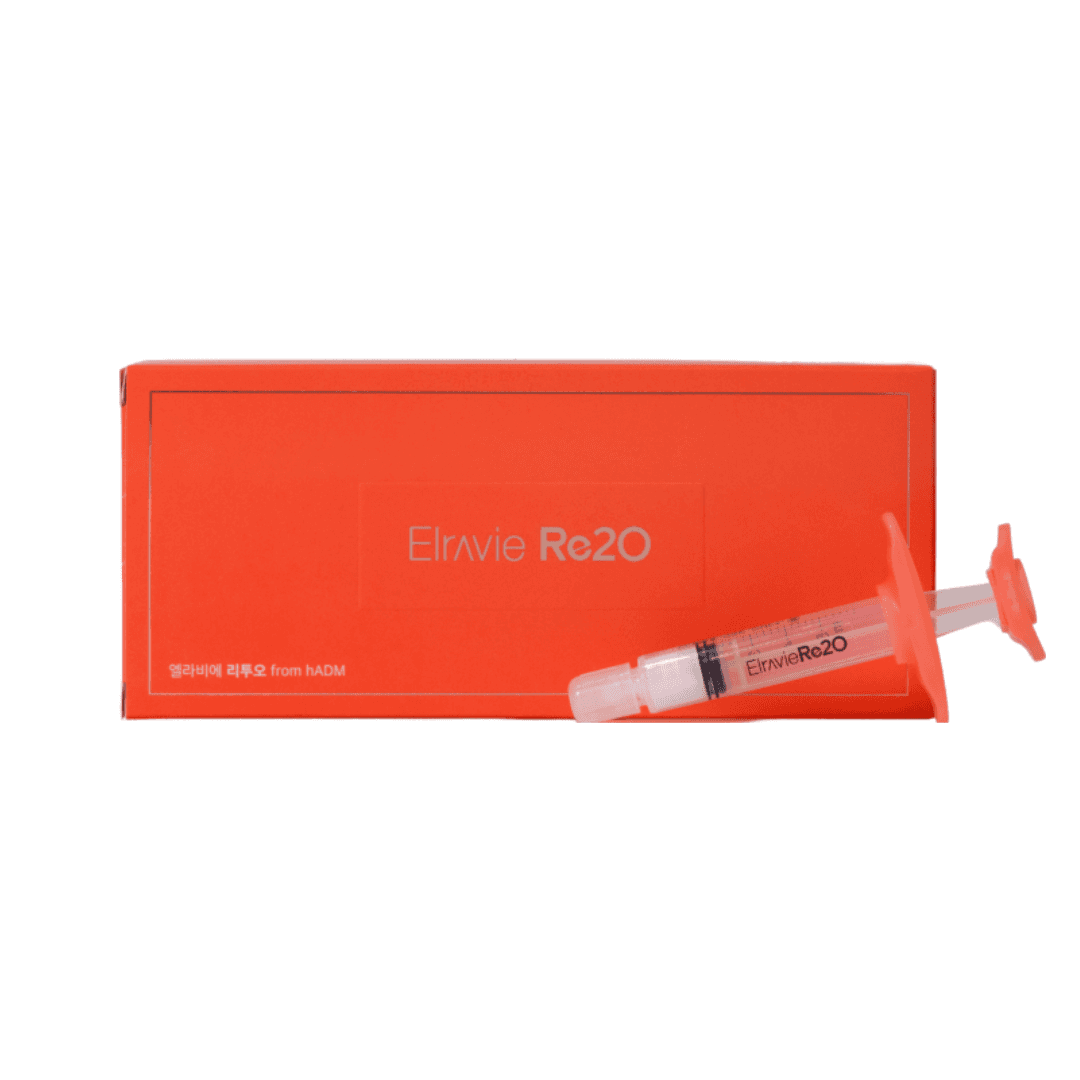
Re20 by Humedix is one of the most-booked skin boosters in Korea since 2024. It works fast and looks dramatic, but the speed of the effect raises questions about what is actually happening in the skin and whether the result is sustainable.
Re20 is a moderately crosslinked hyaluronic acid skin booster by Korean pharma company Humedix, injected superficially across 30–50 points to give same-day hydration and subtle volume restoration. Most patients see a visible glow within 24 hours, and each session lasts 4–6 months. A single Re20 session in Gangnam costs ₩300,000–₩450,000 (≈ $200–$310); a 3-session course is ₩800,000–₩1,200,000.
1–3 sessions, 4 weeks apart · maintenance every 4–6 months
Single Re20 session in Gangnam: ₩300,000–₩450,000 (≈ $200–$310). 3-session course: ₩800,000–₩1,200,000 (≈ $550–$830). Most foreign visitors book 1 session as a one-off for visible glow, rather than a full course — reasonable if the maintenance plan back home is unclear.
What Re20 actually is
Re20 (Elravie Re20) is a high-concentration crosslinked hyaluronic acid (HA) booster by Korean pharma company Humedix. Unlike standard skin boosters — uncrosslinked HA absorbed quickly for hydration — Re20 uses moderately crosslinked HA, the same chemistry as a soft filler, distributed across many small superficial injections. The result blends skin-booster hydration with longer-lasting volume restoration.
Each session uses a single 1ml syringe injected across roughly 30–50 points on cheeks, forehead, and chin. "Re" stands for restoration; "20" refers to the HA molecular weight class.
The same-day effect — and why it works fast
Pure-repair boosters like Rejuran need 2–3 sessions before visible improvement. Re20 is different: most patients see a visible glow and slight plumping within 24 hours of the first session, peaking at week 1–2. The reason is its moderate crosslinking — the HA stays in the skin instead of absorbing in hours, drawing in water for an immediate "filled" appearance. Each session lasts 4–6 months.
For comparison: Rejuran builds across 2–3 sessions and lasts 6–12 months; original Juvelook gives same-day plumping plus an 8–12-week collagen build. For visiting patients who want to leave Korea visibly different after one shot, Re20's speed is the main draw.
Where the controversies start
The same property that makes Re20 fast — its crosslinking — is also what has raised clinical questions since its 2024 launch. Three concerns:
First, distribution risk: crosslinked HA placed superficially across many points carries a small chance of visible bumps or irregular distribution if technique is uneven. This has been documented in Korean reviews at lower-end clinics. Second, longevity uncertainty: Re20 is newer than Restylane Skinbooster or Profhilo, and long-term safety data past 18 months is limited. Third, the marketing language often blurs the line between "skin booster" and "filler," setting up expectations that may not match what the product actually delivers.
Where it works best — and where it does not
Re20 works best on patients with mild to moderate volume loss combined with poor skin quality — typically late 30s through 40s. Combined hydration and subtle volume restoration produces a "well-rested" appearance without the obvious filled look of traditional fillers.
Where it works less well: deep volume loss (needs a structural filler, not a superficial booster), thin or very pigmented skin (crosslinked HA can show through as bluish patches — the Tyndall effect), and patients who simply want hydration (uncrosslinked options are cheaper and lower-risk). Re20 does not fix sagging structure or deep static lines.
Re20 vs Rejuran vs Juvelook — the honest comparison
Rejuran — salmon DNA PN fragments — improves skin quality through regeneration, takes 3 sessions to show effect, lasts 6–12 months. Original Juvelook — PDLLA microspheres plus HA — same-day plumping plus collagen build over 8–12 weeks, lasting 6–12 months. Re20 — moderately crosslinked HA placed superficially — same-day visible volume restoration, lasting 4–6 months.
Simplest mental model: Rejuran fixes texture, Juvelook fixes volume slowly, Re20 fixes both quickly but for a shorter time. Many Korean patients now rotate Re20 with Rejuran or Juvelook depending on their schedule and what they want to see at each visit.
How to lower the risk
For Re20, two things matter more than brand. First, injector technique: even superficial distribution requires a steady hand. Ask whether the doctor (not a nurse or staff injector) is administering Re20, and how many cases per month they personally do.
Second, assessment quality: a clinic that offers Re20 as a default upsell for any consultation is not assessing carefully. A doctor who tells you "Juvelook would actually do more for your face shape" is demonstrating clinical judgment. A clinic that always recommends Re20 because it carries the highest margin is worth being cautious about.
Fun facts & trivia
- Humedix, the maker of Re20, is also the company behind Elravie — a major Korean HA filler brand. Re20 was developed by adapting Elravie filler technology for booster-style superficial use.
- The "20" in Re20 refers to a target molecular weight class, not a concentration percentage, despite how Korean clinic menus often present it.
- Re20 is not yet FDA cleared and is not widely available outside Korea — patients who try it in Seoul cannot easily continue maintenance back home, which is one of the main reasons Korean patients prefer it for one-off "special occasion" prep.
Recurring patient feedback
- The most common review note: "I looked different the next morning." This is unusual for a skin booster and is the single biggest reason Re20 went viral in 2024.
- A meaningful minority of patients report seeing the injection points as small bumps for 24–48 hours after the session. These almost always smooth out, but the first day is not invisible.
- Re20 plus Ultherapy in the same trip is a popular pairing — the Ultherapy lift plus Re20 surface volume produces results most reviewers describe as "the most dramatic thing I have ever booked."
- Long-term reviews (12+ months) are still emerging. Most early adopters have rebooked, but the durability comparison vs Profhilo and original Juvelook is not yet settled.
- A consistent regret: booking Re20 at a high-throughput clinic. The product is technique-sensitive, and uneven distribution is a real complaint at lower-tier clinics.
Common questions
How much does Re20 cost in Korea?
A single Re20 session in Gangnam typically costs ₩300,000–₩450,000 (about $200–$310 USD), and a 3-session course runs ₩800,000–₩1,200,000 (about $550–$830). Most foreign visitors book one Re20 session as a one-off for a visible glow rather than a full course, which is reasonable if the maintenance plan back home is unclear.
How long does Re20 last?
Each Re20 session lasts roughly 4–6 months, shorter than Rejuran (6–12 months) or original Juvelook. Most Re20 patients see a visible glow and slight plumping within 24 hours, peaking at week 1–2. Clinics typically suggest 1–3 sessions, 4 weeks apart, with maintenance every 4–6 months. Long-term safety data past 18 months is still limited.
Is Re20 a filler or a skin booster?
Re20 sits between the two. Re20 uses moderately crosslinked hyaluronic acid, the same chemistry as a soft filler, but distributes one 1 ml syringe across many small superficial injections like a skin booster. The result blends booster-style hydration with subtle, longer-lasting volume restoration, though Re20 does not replace a structural filler for deep volume loss.
Want help navigating this?
Our coordinators are registered medical tourism facilitators accredited under the Korea Ministry of Health. We match you to 2–3 vetted Seoul clinics at real local prices — free, within one business day.
Start a free consultation →Researched by our team through practitioner interviews, on-the-ground market intel, official manufacturer and clinic websites, and Korean-language reviews on UNNI and Naver Blog. Paraphrased — not verbatim quotes, not medical advice. Verify protocols with a licensed physician before booking.