
Every year a handful of treatments quietly take over Korean clinic schedules — not because of one viral campaign, but because patients keep rebooking them. These five are the ones dominating Gangnam waitlists right now.
The five trending treatments at Korean clinics in 2026 are XERF (monopolar RF, a Thermage alternative at $560–$680), Density (RF microneedling with about half the downtime of older devices), Re20 (a crosslinked HA booster with a same-day glow), Ol-Tight (entry-level RF tightening sold by shot count), and Ole-Wave (a newer, gentler HIFU). Most launched between 2023 and 2025 and became default recommendations in 2026.
Varies by treatment — see each section below
XERF (300 shots, full face): ₩810,000–₩990,000 (≈ $560–$680). Density (300 shots): ₩720,000–₩880,000 (≈ $497–$607). Re20 single session: ₩300,000–₩450,000 (≈ $200–$310). Ol-Tight (400 shots): ₩400,000–₩600,000 (≈ $275–$415). Ole-Wave full face: ₩500,000–₩750,000 (≈ $345–$515). Most foreign visitors who book multiple devices in one trip land in the $1,500–$2,800 range for a stacked "trending treatments" course.
Why these five rose to the top
A treatment goes "trending" in a Korean clinic for one of three reasons: it does something older devices could not (true innovation), it does the same thing as a premium device at a fraction of the price (an alternative), or it pairs unusually well with treatments already on the menu (a complement). The five below cover all three patterns.
None are brand-new in 2026 — most launched between 2023 and 2025 — but 2026 is the year their booking volume crossed from "trying it out" to "default recommendation." A consultation in Korea this year will almost certainly include at least one of them.
XERF — the Korean answer to Thermage
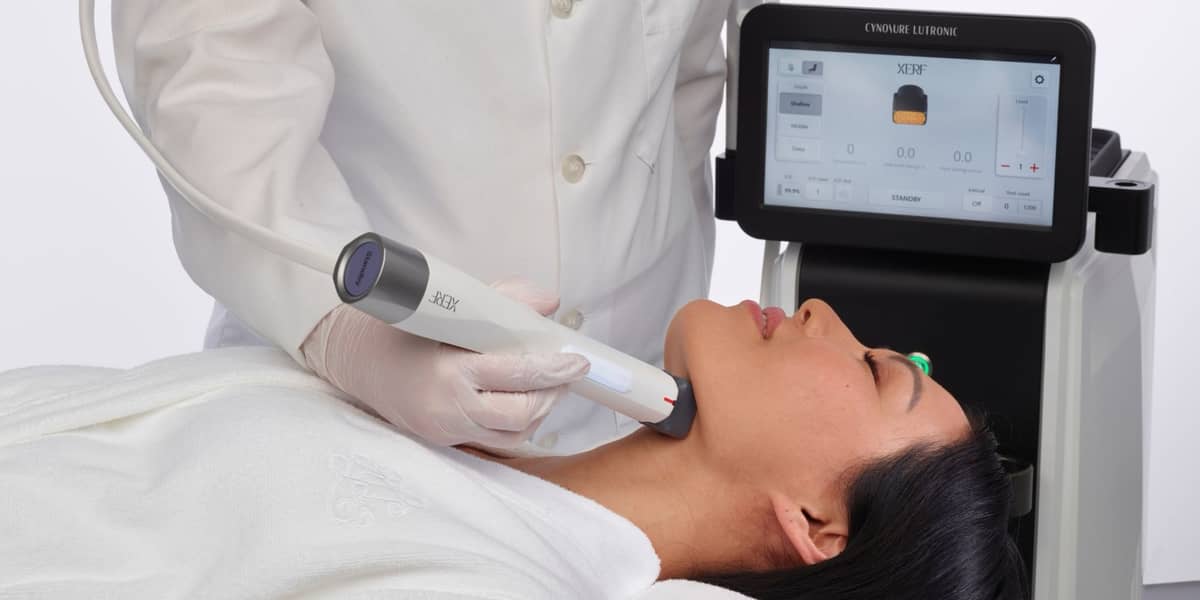
XERF is a Korean monopolar RF device positioned as a direct Thermage FLX alternative. The mechanism is identical — RF heats the dermis, dermis contracts and remodels, collagen builds over months — but cheaper consumable tips pass real savings to the patient: a full-face XERF session in Gangnam runs $560–$680 versus Thermage FLX at $1,400–$2,000.
The honest gap: XERF's output is slightly less uniform than Thermage, so operator skill matters more. At a senior-doctor clinic, XERF produces 80–90% of a Thermage result for less than half the price. At a high-throughput factory clinic, results are uneven. The 2026 pattern: Korean patients in their 30s use XERF as their main yearly tightening treatment and reserve Thermage for special-occasion years.
Density — RF microneedling without the downtime
Density is a Korean RF microneedling device combining insulated microneedles with controlled RF heat delivered directly into the dermis. Compared to older devices (Sylfirm X, Potenza, Morpheus8), Density uses a thinner needle profile and faster pulse cycle, producing less surface trauma — the same dermal heating effect with about half the downtime. Most patients are pinkish for 24 hours instead of red for 3–4 days.
Targets enlarged pores, mild acne scarring, and skin firmness through collagen induction. Korean patients book a 3–4 session course, typically 4 weeks apart. The 2026 pattern: Density is what clinics recommend when patients want RF microneedling results without taking time off work. It stacks well with same-day Aqua Peel and post-treatment exosome topicals.
Re20 — the same-day glow booster
Re20 (Elravie Re20, made by Humedix) is a moderately crosslinked hyaluronic acid booster that sits between a traditional skin booster and a soft filler. Unlike Rejuran or original Juvelook — which require multiple sessions before visible change — Re20 produces a same-day glow and subtle plumping within 24 hours. The moderate crosslinking keeps the HA in the skin for months instead of hours. Each session lasts 4–6 months.
The 2026 pattern: Korean patients book Re20 a week before weddings, photo shoots, or major events because the result lands fast and looks "rested" rather than "treated." For visiting patients, it is the most popular one-off booster on Gangnam menus — a result you can see the next morning. (For the full deep-dive, see our dedicated Re20 guide.)
Ol-Tight (올타이트) — RF tightening with shot count flexibility
Ol-Tight is a Korean monopolar RF device that, like XERF, positions itself as a Thermage alternative. Its differentiator is shot-count flexibility: sessions come in 200, 400, 600, and 900-shot packages, letting clinics offer a "starter" RF tightening at a much lower entry price than Thermage's minimum 300-pulse tip. This makes it popular for younger patients (late 20s through early 30s) who want preventive tightening without justifying a full Thermage session.
The technology is solid Korean RF — comparable to XERF and Density — with the lowest per-shot price of any monopolar RF on the market. The 2026 pattern: Ol-Tight is increasingly the entry-level RF patients try first, upgrading to Thermage or Ultraformer MPT as they age into more visible laxity.
Ole-Wave (올레웨이브) — the new HIFU contender
Ole-Wave is one of several next-generation Korean HIFU devices that emerged in 2024–2025 to compete with Shurink Universe. The core technology is the same — focused ultrasound reaching the SMAS layer to trigger lift through deep coagulation — but Ole-Wave fires at a faster rate using lower per-shot energy with more cumulative passes. Patients describe it as "less of a punch per shot, but the session feels easier overall." Treatment time is shorter and pain ratings are lower than first-generation Shurink.
Long-term outcome data is still limited, as the device has only been in wide use since 2024. The 2026 pattern: clinics use Ole-Wave as the first-time HIFU experience for nervous patients, with an upgrade path to Ultherapy Prime if the result is not enough.
How to use this list
These five are not interchangeable and a good clinic will not recommend all five at once. The decision tree: for skin tightening (firmness, pore refinement) start with XERF or Ol-Tight as the cheaper RF route, or Density if texture work is the priority. For lifting (face shape, jawline definition) start with Ole-Wave at the lower price point or step up to Ultherapy if budget allows. For immediate visible glow before a specific event, book Re20.
Combining is reasonable — Density plus Re20 for a full skin overhaul, or XERF plus Ole-Wave for a tightening-plus-lifting stack — but only with a doctor who maps treatments to your specific face, not a salesperson packaging them for revenue.
Fun facts & trivia
- Korean device makers (Classys, Jeisys, ITC Medical, Lutronic, Humedix) are now the single largest source of new aesthetic device launches globally — more than Israel, Germany, and the US combined as of 2025. Most of these devices launch in Korean clinics first, then export to Asia, then later to Europe and North America.
- The "trending" cycle in Korean aesthetics typically runs 18–24 months from launch to mainstream booking. By the time a Korean device shows up in mainstream US dermatology coverage, it has usually been the default in Seoul for 2 years.
- Re20 went from launch (2024) to becoming the most-booked one-off treatment on Naver booking platform in just 14 months — one of the fastest commercial adoption curves of any Korean injectable in the past decade.
Recurring patient feedback
- XERF reviewers consistently report that the result is real but lasts slightly less than Thermage — most rebook every 9–12 months instead of 12–18.
- Density gets the highest "would recommend to a friend" scores in this group because the downtime is so much shorter than older RF microneedling devices.
- Re20's same-day visible effect is the single most-mentioned positive review across all five — it is the only one of the group where patients describe results in hours, not weeks.
- Ol-Tight reviews are most positive among first-time RF patients; experienced Thermage users typically describe the result as "lighter."
- Ole-Wave reviews are still emerging in 2026, but early reports describe it as "less punishing than Shurink" with slightly less dramatic lifting.
- Across all five, the recurring regret is booking based on price alone — the cheapest option of any device tier rarely matches the marketing claim. Operator skill and clinic tier matter more than which Korean brand sits on the device label.
Common questions
What are the most popular skin treatments in Korea in 2026?
The five treatments dominating Gangnam clinic bookings in 2026 are XERF and Ol-Tight (Korean monopolar RF tightening devices positioned as Thermage alternatives), Density (RF microneedling with shorter downtime), Re20 (a moderately crosslinked hyaluronic acid booster with a same-day glow), and Ole-Wave (a next-generation Korean HIFU for lifting). Most launched between 2023 and 2025 and became default clinic recommendations in 2026.
How much do trending treatments like XERF and Re20 cost in Korea?
In Gangnam, a full-face XERF session (300 shots) costs ₩810,000–₩990,000 (about $560–$680), Density (300 shots) ₩720,000–₩880,000 (about $497–$607), a single Re20 session ₩300,000–₩450,000 (about $200–$310), Ol-Tight (400 shots) ₩400,000–₩600,000 (about $275–$415), and full-face Ole-Wave ₩500,000–₩750,000 (about $345–$515). Visitors stacking several devices in one trip typically spend $1,500–$2,800.
Which Korean treatment gives the fastest visible results?
Re20 (Elravie Re20 by Humedix) gives the fastest visible result of the 2026 trending treatments. Re20 is a moderately crosslinked hyaluronic acid booster that produces a same-day glow and subtle plumping within 24 hours, and each session lasts 4–6 months. Korean patients book Re20 about a week before weddings, photo shoots, or major events; RF and HIFU devices take weeks to months.
Want help navigating this?
Our coordinators are registered medical tourism facilitators accredited under the Korea Ministry of Health. We match you to 2–3 vetted Seoul clinics at real local prices — free, within one business day.
Start a free consultation →Researched by our team through practitioner interviews, on-the-ground market intel, official manufacturer and clinic websites, and Korean-language reviews on UNNI and Naver Blog. Paraphrased — not verbatim quotes, not medical advice. Verify protocols with a licensed physician before booking.