
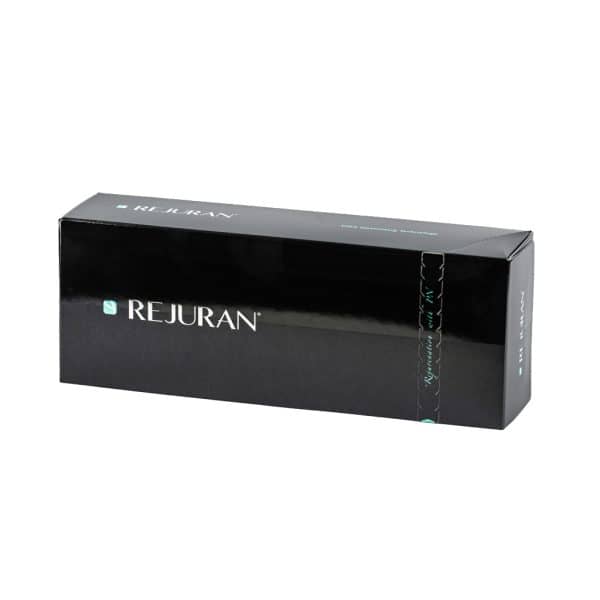
Rejuran is the basic "repair shot" you will be offered at almost every Gangnam skin clinic — and the one treatment most foreign visitors leave Seoul having tried at least once.
Rejuran is a polynucleotide (PN) injection made from purified salmon DNA that signals the skin to repair itself, building collagen and smoothing texture rather than adding volume. In Gangnam, a session typically costs ₩200,000–₩450,000 (about $150–$350 USD). Most Korean patients book 3–4 sessions, 2–4 weeks apart, with maintenance every 6–12 months.
3–4 sessions, 2–4 weeks apart · maintenance every 6–12 months
In Gangnam, expect ₩200,000–₩450,000 per session (about $150–$350 USD). Many clinics now advertise a "same price for foreigners" policy, so foreign patients usually pay the same rate as locals — this has become a standard marketing claim rather than a special offer. Full cost guide →
What does Rejuran actually do?
Rejuran is a healing injection. The active ingredient is purified salmon DNA in polynucleotide (PN) form — long-chain DNA fragments that act as repair signals. The often-confused molecule PDRN is a shorter-chain version used in different products (like Italian Plinest); Rejuran uses the higher-molecular-weight PN form.
The doctor injects dozens of small drops just under your skin across the face. Those PN fragments do not add volume like a filler or relax muscles like Botox. They act as a "wake up" signal to your skin's own repair cells: build more collagen, grow new tiny blood vessels, smooth texture. Over the next 2–4 weeks your skin looks smoother, better hydrated, with tighter-looking pores. Not "done." Rested.
The salmon DNA story
Italian researchers in the 1980s pioneered wound-healing uses of salmon-DNA polymers, with PDRN becoming established for tissue repair. Korean biotech Pharma Research Products developed its own PN extraction process in the 2000s and launched Rejuran in 2014 as an aesthetic injection.
Why salmon? Its DNA is structurally similar enough to human DNA that our cells respond to its repair signals, but different enough not to trigger an allergic reaction. Rejuran stayed niche until 2019–2021, when "Korean glass skin" videos went viral on TikTok — pushing it from a small dermatology tool to a worldwide booking driver.
Why is it still trending?
Searches for "Rejuran" are up more than 200% year-over-year heading into 2026, pulling over five million weekly TikTok views. Korean clinics now stock a whole product family: Rejuran Healer for general rejuvenation, Rejuran S for acne scars, Rejuran I for under-eye skin, and Rejuran Tone-Up Booster for brightness.
A typical Gangnam consultation will offer you at least three of these. Knowing which one you actually want before you walk in saves time and money.
What does a session feel like?
Numbing cream goes on first for about 20 minutes. Then the injector walks a thin needle across your cheeks, chin, and forehead in a grid — dozens of injections in roughly 10 minutes. Most people describe it as "tiny paper cuts."
Right after, you'll see small bumps at every injection point. They look like an allergic reaction but are not — just small drops of liquid settling under the skin. They resolve within 24–48 hours. Most Korean patients plan a "stay home" day and are back to normal by day two.
Rejuran or Juvelook? How to pick
Both are biostimulators — injectables that trigger your own collagen rather than adding direct volume. Rejuran is PN-only: pure repair and hydration, better skin quality without changing shape. Juvelook combines PDLLA particles (a slow-dissolving polymer that prompts collagen growth) with hyaluronic acid, giving a same-day plumping effect Rejuran cannot match.
Quick rule: if your skin looks tired (rough texture, dullness, fine lines), pick Rejuran. If your face looks deflated (flatter cheeks, slight sagging), pick Juvelook. Most Koreans who try both eventually settle on one and rotate year by year.
A 1-week Korea trip plan
For a 5–7 day trip, the standard schedule is: day 1, Rejuran plus Aqua Peel; day 3, a laser session if you have pigment concerns; day 5, the second Rejuran if you booked a 2-session package; fly home day 7. This stacks the visible bumps into the first half of the trip, so by day 6–7 you look photo-ready. Many Gangnam clinics sell this exact bundle as a "travel package" with a small discount.
Fun facts & trivia
- Rejuran was nearly never sold as a beauty product. The early research was for healing wounds after surgery — the "glass skin" branding came years later.
- The 2022–2023 demand spike was driven less by ads and more by Korean reality-TV before-and-afters. The oldest viral "rejuran before after" clips on Korean YouTube are unsponsored patient diaries.
- Polynucleotides (PN) attract water, which is why Rejuran is almost never mixed with lidocaine (a numbing drug) in Korea — practitioners report that mixing changes the viscosity and may weaken the result. If a clinic offers lidocaine-mixed Rejuran, ask why.
Recurring patient feedback
- Most Koreans say the soft "filter glow" only really shows up after the second session, not the first. Patience matters — do not judge it after one visit.
- Rejuran I (the under-eye version) gets mixed reviews. Some people love the smoothing; others say the small bumps under the eyes stay visible for 3–5 days.
- A common pairing: Rejuran on the same day as RF microneedling (devices like Potenza or Sylfirm X). Reviewers say acne scars soften faster this way.
- Foreign patients often mention the "travel package" discount at Gangnam clinics — usually 5–15% off when you book a 2-session course plus an extra treatment.
- The most common regret in reviews: booking a single Rejuran session, seeing little change, and saying "it does not work." The Korean rule of thumb is that 3 sessions is the minimum to actually judge it.
Common questions
How much does Rejuran cost in Korea?
In Gangnam, Rejuran typically costs ₩200,000–₩450,000 per session, roughly $150–$350 USD. Many Seoul clinics advertise a "same price for foreigners" policy, so foreign patients usually pay the same rate as locals. Clinics often sell a two-session "travel package" with an extra treatment at a 5–15% discount.
Is Rejuran painful?
Rejuran involves dozens of small injections across the cheeks, chin, and forehead in about 10 minutes, after roughly 20 minutes of numbing cream. Most people describe the sensation as "tiny paper cuts." Small bumps appear at each injection point and resolve within 24–48 hours; most Korean patients plan one stay-home day.
How many Rejuran sessions do I need?
Most Korean clinics recommend 3–4 Rejuran sessions spaced 2–4 weeks apart, then maintenance every 6–12 months. The Korean rule of thumb is that three sessions is the minimum needed to judge results, and many patients say the soft "filter glow" only really shows up after the second session.
Want help navigating this?
Our coordinators are registered medical tourism facilitators accredited under the Korea Ministry of Health. We match you to 2–3 vetted Seoul clinics at real local prices — free, within one business day.
Start a free consultation →Researched by our team through practitioner interviews, on-the-ground market intel, official manufacturer and clinic websites, and Korean-language reviews on UNNI and Naver Blog. Paraphrased — not verbatim quotes, not medical advice. Verify protocols with a licensed physician before booking.