
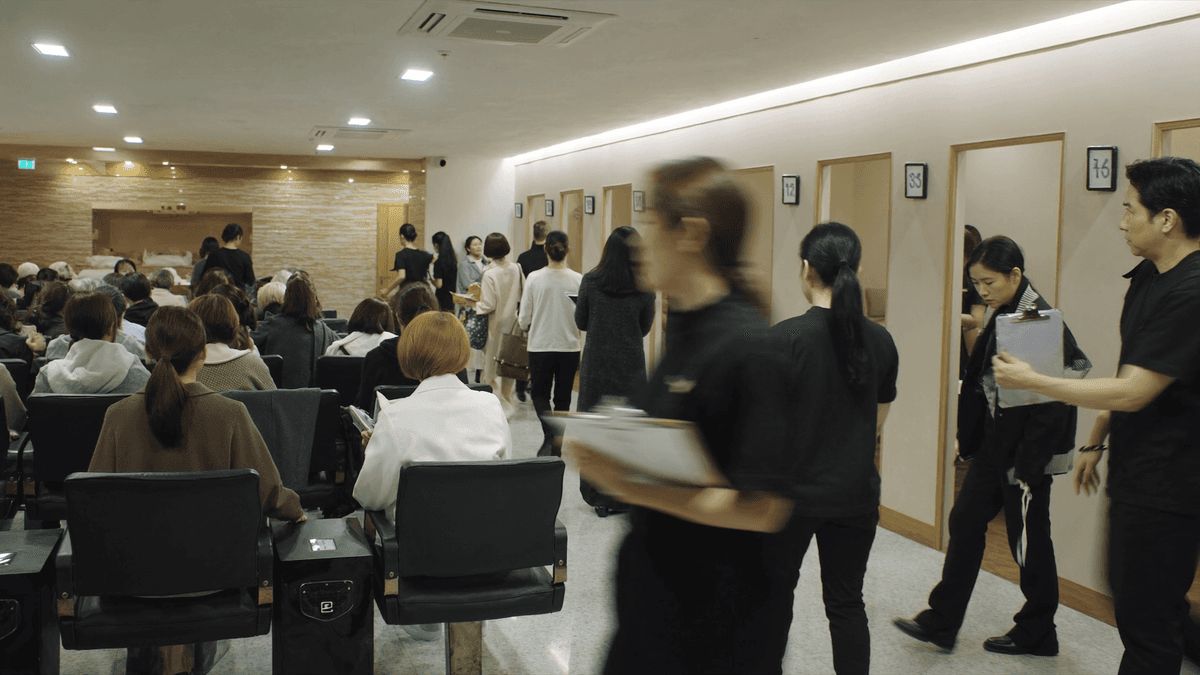
Factory clinics are the most argued-about format in Korean aesthetic medicine. They are not all unsafe — but they are not the same as small boutique clinics either.
Factory clinics are high-volume Korean aesthetic clinics with 15 to 50 staff, where doctors rotate between rooms. They work well for low-variance treatments such as one-area Botox, standard filler, HIFU maintenance and laser toning, often at 20 to 40 percent lower prices. They work against you for revision surgery, custom work or unusual anatomy, where a small boutique clinic is worth the premium.
What a factory clinic is
A factory clinic is a high-volume aesthetic clinic — typically 15 to 50 staff, 5 to 15 treatment rooms running simultaneously, heavy advertising, and aggressive package deals. Surgeons and injectors rotate between rooms. The lead doctor whose face is on the brand handles the consultation and oversight, but actual treatment is shared among staff doctors. Korean 2025 data puts these clinics at roughly 35 to 40 percent of plastic-surgery bookings in Seoul, plus a smaller share of injectables.
The honest pros
Factory clinics are not automatically unsafe. A well-run one typically has better equipment than a small clinic (volume pays for top-tier devices), faster scheduling (often same-week), lower prices (20 to 40 percent volume discounts), and proper infrastructure (recovery rooms, anesthesia-trained staff, surgical nurses). For standard non-surgical treatments — Botox, regular filler, HIFU, laser toning — a factory clinic often delivers the same quality as a boutique at half the price.
The honest cons
Where factory clinics fall short: personal attention, follow-up consistency, and surgeon-specific skill. The doctor who consults you is often not the one who treats you. Follow-up visits rotate through different staff. For treatments where craft matters — revision work, complex nose jobs, facial feminization, custom thread-lift patterns — the factory model works against you. Korean malpractice data from 2025 leans heavily toward factory clinics for revision and complex cases.
When a factory clinic is the right choice
When the result does not vary much from doctor to doctor: one-area Botox, standard HA filler in a safe spot, HIFU maintenance, a laser toning course, Aqua Peel, Rejuran. For these, the factory price-to-quality ratio is hard to beat. Some factory chains are also genuinely good at standardized first-time surgeries like primary nose jobs or double-eyelid surgery, because the volume produces real skill at those specific procedures.
When to avoid a factory clinic
Avoid factory clinics for: any revision surgery, any custom work where the specific plan is the whole point, unusual anatomy (strong asymmetry, prior surgical scars, a bad outcome from another clinic), or if you want the same surgeon from consultation through closing stitches. For these cases, a small "1-on-1" or VIP-style clinic is worth two to three times the price.
Key takeaways
- Factory clinics are not unsafe by default — they trade personal attention for volume.
- For routine non-surgical treatments, factory clinics often beat boutiques on price per quality.
- For revision or complex surgery, the factory model works against your outcome.
- About 35 to 40 percent of Seoul plastic-surgery bookings happen at factory clinics — they are the dominant format.
Protection tips
- For factory-clinic surgery, get in writing who does each part of the operation.
- Use factory clinics for low-variance treatments — standard injectables, routine HIFU.
- Pay the boutique premium when your treatment plan needs to be tailored to you specifically.
Common questions
What is a factory clinic in Korea?
A factory clinic in Korea is a high-volume aesthetic clinic, typically with 15 to 50 staff, 5 to 15 treatment rooms running simultaneously, heavy advertising and aggressive package deals. Surgeons and injectors rotate between rooms: the lead doctor handles consultation and oversight while treatment is shared among staff doctors. Korean 2025 data puts factory clinics at roughly 35 to 40 percent of Seoul plastic-surgery bookings.
Are factory clinics in Korea safe?
Factory clinics in Korea are not automatically unsafe. A well-run factory clinic often has better equipment than a small clinic, faster scheduling, 20 to 40 percent volume discounts and proper infrastructure such as recovery rooms and anesthesia-trained staff. The trade-off is personal attention and follow-up consistency, and Korean 2025 malpractice data leans heavily toward factory clinics for revision and complex cases.
When should I choose a boutique clinic over a factory clinic in Korea?
Choose a small boutique or 1-on-1 clinic over a Korean factory clinic for any revision surgery, custom work where the specific plan is the whole point, unusual anatomy such as strong asymmetry or prior surgical scars, or when you want the same surgeon from consultation through closing stitches. For these cases a boutique clinic is worth two to three times the price.
Want help navigating this?
Our coordinators are registered medical tourism facilitators accredited under the Korea Ministry of Health — not the unlicensed brokers this article warns about. We match you to 2–3 vetted Seoul clinics at real local prices — free, within one business day.
Start a free consultation →Researched by our team through practitioner interviews, on-the-ground market intel, official sources (MFDS enforcement records, KOIHA registered-facilitator data, Korean Society of Dermatologic Surgery), and Korean-language investigative reporting (Chosun Biz, KBS, Hankyoreh). Paraphrased — not medical or legal advice.