
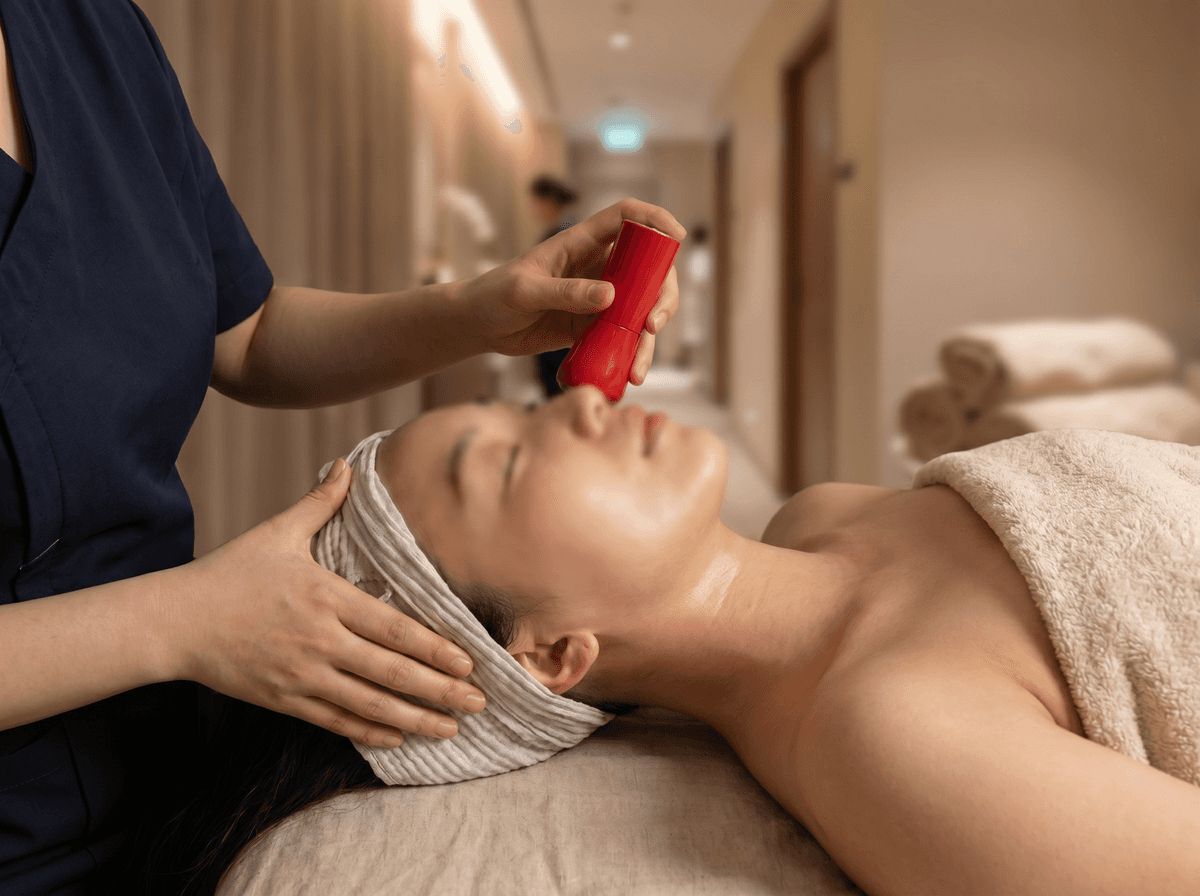
Korean law — not the look of the place — separates a beauty salon from a medical clinic. A meaningful share of complications comes from medical procedures done on the wrong side of that line.
Korean beauty shops are licensed under the Public Health Act for cosmetic-only services, while medical clinics operate under the Medical Act. Every injection, laser, HIFU or energy-device procedure is a medical act that only a licensed doctor can perform. To confirm a place is a real clinic, check the HIRA database at hira.or.kr and look for the establishment permit in the lobby.
Where Korean law draws the line
The Korean Medical Act defines a "medical act" as any procedure requiring medical judgment that could cause harm if done badly. Korean courts have ruled this covers all needle injections (Botox, fillers, skin boosters, PRP, mesotherapy), all laser and energy devices above cosmetic strength (IPL, fractional laser, HIFU, RF microneedling), and anything that breaks the skin. These can only be performed by a licensed doctor — or, in narrow cases, by a licensed nurse under direct doctor supervision.
A beauty shop ("esthetic shop"), regardless of how it advertises itself, cannot legally perform any of these in Korea.
What beauty shops are legally allowed to do
Korean beauty shops are licensed under the Public Health Act, not the Medical Act. Their legal scope covers: facial massage and manual skincare, cosmetic-grade topical products, hydrafacial-style machines at purely cosmetic energy levels (no skin penetration), eyebrow shaping and eyelash work, and low-energy LED light therapy within cosmetic-device rules. Anything that goes through the skin, heats deeper layers, or introduces a substance into the body is outside this scope.
Beauty businesses typically use "care" or "management" in their names; medical clinics are called "clinic" or "dermatology." That naming difference is the visible signal.
How illegal procedures end up happening anyway
Despite a clear legal line, illegal procedures still happen in beauty shops. The mechanics: shops can legally buy the same equipment used in medical clinics (RF microneedling units, Potenza variants, IPL machines) — the law restricts how devices are used, not who can purchase them. Staff get informal training from device-company sales reps with no medical license. The shop describes procedures as "care" rather than "medical treatment" in marketing to dodge the legal label. The MFDS has been raiding more shops every year since 2022, but enforcement is patchy and fines are small relative to revenue.
Why the setting matters even when the device is the same
The danger of a beauty shop running an energy-device procedure is not mainly that the device is worse — the hardware may be identical to a clinic's. The danger is the missing medical-response system. When a burn occurs during RF or laser (a known risk at any setting), the right response involves specific cooling, wound care, and a prescription to manage PIH. None of that is available in a beauty shop. When an injectable complication happens — allergic reaction, infection, vascular occlusion — the shop has no hyaluronidase, no oxygen, no path to emergency care, and no medical professional to assess severity. The device is 20 percent of the risk. The setting is 80 percent.
How to confirm you are at a medical clinic
Every Korean medical clinic is listed in the HIRA database (Health Insurance Review and Assessment Service), searchable at hira.or.kr. If a place is not in HIRA, it is not a licensed medical clinic — regardless of what it calls itself. Every Korean medical clinic must also display its "medical institution establishment permit" — a government document showing the clinic name, licensed doctor's name, and permit number. Look for it in the lobby. If you cannot find it, ask. A real clinic will produce it immediately.
Why foreign visitors are at higher risk here
Foreign patients are especially exposed for two reasons. First, beauty shops in tourist-heavy areas (Myeongdong, Hongdae, Insadong) market aggressively to foreigners — English-language brochures, prices lower than medical clinics, and language framing procedures as beauty services rather than medical interventions. Second, without Korean, checking the HIRA database or establishment permit before arrival is not obvious.
The simplest rule: if the place does not list a licensed doctor on staff (name, photo, and specialty on the website), do not get any injection or energy-device procedure there.
Key takeaways
- Korean law restricts every injection, laser, HIFU, and energy-device procedure to licensed medical clinics — beauty shops cannot legally do them.
- Beauty shops are licensed under the Public Health Act for cosmetic-only services, not the Medical Act.
- The setting matters clinically: beauty shops have no medical-response system if a complication happens.
- The HIRA database and the clinic's establishment permit are the two tools that confirm a place is a real medical clinic.
Protection tips
- Verify the clinic appears in HIRA (hira.or.kr) before booking any injection or energy-device treatment.
- Look for the medical institution establishment permit displayed in the clinic lobby — ask if you cannot find it.
- If the place does not list a licensed doctor by name on its website, do not get any medical procedure there.
- Avoid any tourist-area place that calls injections or laser "care" instead of "medical procedure" — the wording is often a legal dodge.
Common questions
Can a beauty shop in Korea legally do Botox or laser?
No. Under the Korean Medical Act, all needle injections (Botox, fillers, skin boosters, PRP, mesotherapy), all laser and energy devices above cosmetic strength (IPL, fractional laser, HIFU, RF microneedling) and anything that breaks the skin are medical acts. Korean beauty shops are licensed under the Public Health Act and cannot legally perform any of them, regardless of how they advertise.
How do I check if a Korean clinic is a licensed medical clinic?
Every licensed Korean medical clinic is listed in the HIRA (Health Insurance Review and Assessment Service) database, searchable at hira.or.kr; a place not in HIRA is not a licensed medical clinic whatever it calls itself. Every Korean medical clinic must also display its medical institution establishment permit, showing the clinic name, licensed doctor's name and permit number, usually in the lobby.
Why is it dangerous to get a laser or injection at a Korean beauty shop?
The hardware at a Korean beauty shop may be identical to a clinic's; the danger is the missing medical-response system. If a laser or RF burn occurs, a beauty shop cannot provide proper cooling, wound care or a prescription for PIH. If an injectable complication occurs, there is no hyaluronidase, no oxygen, no path to emergency care and no medical professional to assess severity.
Want help navigating this?
Our coordinators are registered medical tourism facilitators accredited under the Korea Ministry of Health — not the unlicensed brokers this article warns about. We match you to 2–3 vetted Seoul clinics at real local prices — free, within one business day.
Start a free consultation →Researched by our team through practitioner interviews, on-the-ground market intel, official sources (MFDS enforcement records, KOIHA registered-facilitator data, Korean Society of Dermatologic Surgery), and Korean-language investigative reporting (Chosun Biz, KBS, Hankyoreh). Paraphrased — not medical or legal advice.