
Three thread materials, three different lifespans, three different price points. A practical guide to choosing without the sales pitch.
PDO, PLLA, and PCL are the three dissolvable thread-lift materials. PDO threads dissolve in about 6 months, cost the least, and give the most immediate lift; PLLA lasts 12–18 months with more collagen stimulation; PCL lasts 18–24 months with the strongest collagen response but costs the most. Most Korean 30-somethings book 6–12 "shopping threads" using a PDO and PLLA mix, at roughly ₩800,000–₩1.8M.
1 session · maintenance every 12–18 months
6–12 shopping threads: $600–$1,200. Full mid-face plus jawline PDO + PLLA combo: $1,500–$2,500. PCL-only: $1,800–$3,500. If you need a different clinic to fix a bad thread lift, expect $400–$800 for thread removal and tissue repair. Full cost guide →
What is a thread lift, in plain English
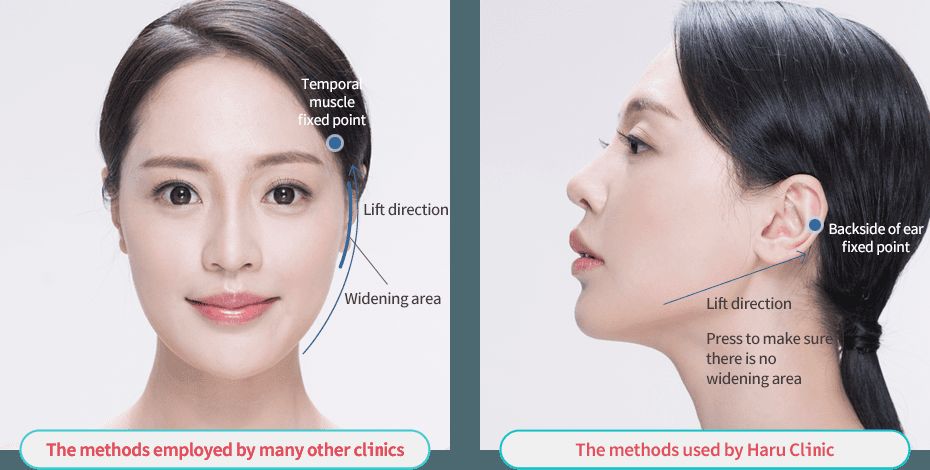
A thread lift uses small dissolvable threads with tiny barbs along them. The doctor inserts the threads through a thin needle puncture (no surgical cut). Once in place, the barbs catch the underside of the skin and tissue, and the doctor uses them to physically lift sagging areas upward.
Over the next several months, the body breaks down the thread and replaces it with new collagen, which holds the lift after the thread is gone. PDO, PLLA, and PCL refer to the thread material. All three dissolve eventually — but at different speeds and with different side-effect profiles.
The three materials, compared
PDO (polydioxanone) threads dissolve in about 6 months, are the cheapest, and give the most immediate lift — the thread pulls tissue up while barbs hold it as collagen grows in. PLLA (poly-L-lactic acid) lasts 12–18 months, stimulates more collagen, but the initial lift is gentler. PCL (polycaprolactone) is the newest — 18–24 months, strongest collagen response, but the most expensive per thread and the hardest to correct if uneven.
Korean clinics often combine PDO and PLLA in a single session: PDO handles the immediate lift while PLLA continues stimulating collagen as the PDO dissolves.
How the procedure has changed over time
Early Korean thread lifts in the 2000s were single-thread procedures, often on the nose. By the early 2010s, mid-face lifts arrived: long, heavily-barbed threads pulled through small temple cuts. Then in 2018 came the "shopping thread" revolution — short, densely-barbed mini-threads inserted through tiny needle punctures, no surgical cuts at all.
A typical modern Korean thread lift uses 6–12 mini-threads across the mid-face and jawline, takes 30–40 minutes, and leaves bruising and swelling for 3–7 days. The 2025 version is almost a different procedure from the original thread lift of 15 years ago.
Why operator skill matters more than thread brand
A well-placed PDO thread lift outperforms a badly-placed PLLA one. The complications people fear — dimples, thread ends pressing through skin, asymmetry, sharp facial angles — are operator problems, not material problems.
The question that matters is not "which thread material" but "how many thread lifts does this doctor do per week?" An honest answer from a specialized clinic is usually 10–40. Below 5, and you are paying for the doctor's practice cases.
Why US clinics gave up on threads, then came back
The US had a brief thread-lift boom in 2015 that fell apart by 2017. Bad outcomes at high-volume medspas wrecked the category's reputation. Korea — with more trained doctors and stricter product regulation — kept doing thread lifts well, refining technique through 2018–2023.
By 2024, Korean-trained specialists were opening US clinics and the technique re-entered American aesthetic medicine, this time refined. The 2015 thread lift and the 2025 thread lift share a name but are almost completely different procedures.
What 30-something Korean patients actually book
The dominant 2025–2026 pattern: 6–12 "shopping threads" using a PDO and PLLA mix, placed across the mid-face and jawline, 30–40 minutes in the chair, total cost ₩800,000–₩1.8M. Korean reviewers describe it as "the lift before a wedding, interview, or photoshoot" — not a surgery replacement, but a 12–18 month firm-up that pairs well with HIFU or Emface.
The most satisfied reviews come from patients who alternate thread lifts with HIFU on a quarterly schedule, rather than relying on either alone.
Red flags: what a bad thread lift looks like
Warning signs from Korean reviews: visible dimpling lasting more than 2 weeks; thread ends you can feel or see through skin (placed too shallow); a jawline visibly tighter on one side; threads that "migrate" (barbs failed to anchor). These problems usually self-resolve once the threads dissolve — but the wait is 6–12 months, not a same-day fix.
Avoid clinics that offer to add a second set of threads on top of a botched first set. Wait until the original threads are fully dissolved before doing anything else.
Fun facts & trivia
- The "shopping thread" name comes from a Korean phrase meaning "as casually as going shopping." It reflects how routine the mini-thread treatment has become in Korea.
- PCL threads break down into 6-hydroxycaproic acid and water through hydrolysis — a different byproduct from the lactic acid produced by PLA-based dissolvable stitches. That is why PCL is considered the safest of the three despite being the newest.
- Korean thread-lift training is now its own track at aesthetic medicine conferences. The most famous instructor courses are taught in Seoul and pull surgeons from across Southeast Asia.
Recurring patient feedback
- Bruising and swelling for 3–7 days is universal — plan for downtime. Reviewers who scheduled their thread lift the day before flying home almost all regret it.
- Combining threads with Ultherapy in the same month sometimes backfires — the ultrasound energy can weaken threads that have not dissolved yet. Korean clinic consensus is to space them at least 3 months apart.
- PCL-only packages are marketed as "the long-lasting option," but reviews suggest your outcome still comes down to the doctor's skill, not the material.
- The most enthusiastic reviews almost always mention 6–12 threads done "for an event" — wedding, photoshoot, class reunion — rather than as ongoing maintenance.
- A small number of reviewers report tightness or soreness for 2–3 weeks. This is normal for well-placed threads. Visible dimples alongside that soreness, however, are not normal.
Common questions
What is the difference between PDO, PLLA, and PCL threads?
PDO (polydioxanone) threads dissolve in about 6 months, are the cheapest, and give the most immediate lift. PLLA (poly-L-lactic acid) threads last 12–18 months and stimulate more collagen, but the initial lift is gentler. PCL (polycaprolactone) threads are the newest, lasting 18–24 months with the strongest collagen response, but cost the most per thread and are hardest to correct if uneven.
How much does a thread lift cost in Korea?
In Korea, 6–12 "shopping threads" typically cost $600–$1,200. A full mid-face plus jawline PDO and PLLA combination runs $1,500–$2,500, and a PCL-only thread lift costs $1,800–$3,500. The dominant 2025–2026 booking, a PDO and PLLA mix across the mid-face and jawline, totals about ₩800,000–₩1.8M. Thread removal and repair at another clinic costs $400–$800.
How long does a thread lift last?
A thread lift's duration depends on the material: PDO threads dissolve in about 6 months, PLLA lasts 12–18 months, and PCL lasts 18–24 months. Korean clinics typically plan maintenance every 12–18 months. Korean reviewers describe the common PDO and PLLA shopping-thread lift as a 12–18 month firm-up rather than a surgery replacement, often paired with HIFU or Emface.
Want help navigating this?
Our coordinators are registered medical tourism facilitators accredited under the Korea Ministry of Health. We match you to 2–3 vetted Seoul clinics at real local prices — free, within one business day.
Start a free consultation →Researched by our team through practitioner interviews, on-the-ground market intel, official manufacturer and clinic websites, and Korean-language reviews on UNNI and Naver Blog. Paraphrased — not verbatim quotes, not medical advice. Verify protocols with a licensed physician before booking.