
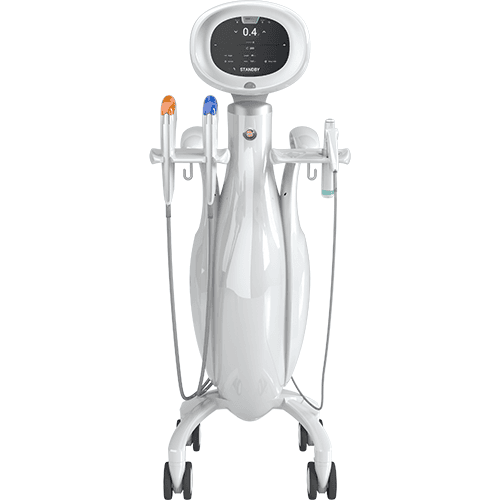
Thermage and Ultherapy are the gold standard, but they are also the most expensive. A wave of alternatives — Shurink, Ultraformer, XERF, and Sofwave — promise similar results at a fraction of the price. Some deliver. Some do not.
The main lower-cost alternatives to Thermage and Ultherapy in Korea are Shurink Universe, Ultraformer MPT, XERF, and Sofwave, priced at roughly 30–60% of the premium devices. Ultraformer MPT is the closest to Ultherapy; Shurink Universe suits budget HIFU maintenance every 6–9 months; XERF is a Thermage-style RF option; Sofwave is the most comfortable but tightens more than lifts. None is a one-to-one substitute.
Most alternatives: 1 session every 6–9 months (more frequent than Thermage/Ultherapy)
Shurink Universe (full face + neck) in Gangnam: $400–$900. Ultraformer MPT: $700–$1,300. XERF (300 shots): $500–$900. Sofwave (full face): $900–$1,400. Versus Thermage at $1,400–$2,000 and Ultherapy at $1,400–$2,000, the alternatives sit at 30–60% of premium pricing. Full cost guide →
Why alternatives exist in the first place
A Thermage tip or Ultherapy cartridge costs the clinic $400–$800, which is why the patient price has to reach $1,400+ for the clinic to break even. Korean and Israeli device makers spotted that price ceiling and built alternatives using cheaper consumables and less specialized training — delivering 60–80% of the original effect at 30–50% of the price.
For patients maintaining results yearly, this changes the math entirely: an Ultherapy session every 18 months may cost the same as a Shurink session every 9 months over a five-year span.
Shurink Universe (the Korean market name for Classys's next-gen HIFU; the export-market equivalent is sold as Ultraformer MPT, with the older Ultraformer III being a previous-generation device)
Shurink Universe (Classys) is the most popular Ultherapy alternative globally. Like Ultherapy, it uses focused ultrasound to reach the SMAS layer. Unlike Ultherapy, it has no built-in imaging — the operator fires at a fixed depth based on the chosen cartridge, without confirming where energy actually lands. In Asian skin, where dermal thickness is more predictable, this works well in skilled hands. Shurink also uses cheaper cartridges that fire more shots per session, so per-shot coverage is higher.
Honest summary: Shurink at a high-end Gangnam clinic with a senior doctor produces 70–85% of an Ultherapy result for about 40% of the price. Quality variance across clinics is wider than Ultherapy, so where you book matters more.
Ultraformer MPT — the upgraded Korean HIFU
Ultraformer MPT (Classys) is the latest Korean HIFU iteration, designed to compete with Ultherapy Prime rather than just undercut it. MPT stands for Micro Pulse Technology — shorter, faster pulses that reduce discomfort and session time. Reviews in 2025–2026 are positive: patients report it feels noticeably more comfortable than older HIFU and produces results closer to Ultherapy than first-generation Shurink.
Pricing sits between Shurink Universe and Ultherapy Prime. For patients who found older HIFU unbearable but cannot stretch to Ultherapy, Ultraformer MPT is the most logical middle ground.
XERF — the Korean RF answer to Thermage
XERF is a Korean monopolar RF device positioned as a direct Thermage alternative. The mechanism is identical — RF heats the dermis, the dermis contracts and remodels — but cheaper consumable tips let clinics price sessions at $500–$900 instead of Thermage's $1,400+.
The honest gap: XERF's RF output is slightly less uniform than Thermage FLX and the tip glide is not as smooth, so operators must work more carefully to avoid hot spots. In skilled hands the result is genuinely similar. At a high-throughput factory clinic, it can be uneven. Book XERF at a clinic with experienced operators; avoid clinics that just added it to fill a menu slot.
Sofwave — the new ultrasound that is not HIFU
Sofwave uses Synchronous Ultrasound Parallel Beam (SUPERB) technology. Unlike HIFU, which focuses energy at a single deep point, Sofwave delivers parallel beams to a shallower 1.5mm depth, heating the mid-dermis broadly rather than the SMAS specifically. The result is more skin tightening than true lifting — closer to Thermage than Ultherapy. Sofwave got FDA clearance for "lifting" in 2022, but most clinicians describe its effect as predominantly tightening with mild lift.
Comfort is a major selling point: much less painful than HIFU, with no jaw or bone-tap sensation. A reasonable pick for patients who want a Thermage-style result with shorter session time.
How to actually choose
Simple decision tree: for the closest thing to Ultherapy at a lower price, book Ultraformer MPT at a senior-doctor clinic. For budget maintenance HIFU every 6–9 months, book Shurink Universe at a reputable Gangnam clinic. For Thermage-style RF tightening at half the price, book XERF — but only where you can confirm operator experience. For shorter, more comfortable sessions with tightening over true lifting, book Sofwave.
The wrong move is expecting any of these to be a 1:1 Ultherapy or Thermage substitute at dollar value. They are alternatives, not equals. The price gap reflects a real gap in output, comfort, longevity, or imaging precision.
Fun facts & trivia
- Classys, the maker of Shurink and Ultraformer, is now the largest aesthetic device exporter in Korea by revenue — bigger than the global brands they originally cloned. Their devices are used in over 70 countries.
- Sofwave was developed in Israel and is used heavily in the US and Europe, but it never became the default in Korea because Korean patients are already familiar with HIFU and prefer the deeper SMAS effect.
- XERF is one of dozens of Korean RF devices that emerged in 2020–2023 to compete with Thermage. The market sorted itself by 2025 — XERF, Density, and a few others survived; many smaller brands disappeared. If a clinic offers a Korean RF device you have not heard of, it may be a discontinued model.
Recurring patient feedback
- Shurink reviewers consistently say results land at week 6–8 rather than week 10–12 (faster than Ultherapy), but fade earlier — most rebook at month 7–9 instead of month 12.
- Ultraformer MPT reviews in 2026 are notably better than older Shurink reviews — patients describe it as "Ultherapy without the wallet damage."
- XERF reviewers describe results as "Thermage-lite" — a real effect, but not quite as dramatic. Most rebook every 9–12 months instead of 12–18.
- Sofwave gets the highest comfort scores in this group — many patients describe it as "almost painless." The tradeoff is less dramatic lifting; the firmness gain is real but subtle.
- A common regret across all four: booking the cheapest option without checking the device model. Many factory clinics quietly substitute older Shurink machines or generic Chinese HIFU clones — the tier of device, not just the brand name, matters.
Common questions
What is the best cheaper alternative to Ultherapy in Korea?
Ultraformer MPT is the closest lower-cost alternative to Ultherapy, priced between Shurink Universe and Ultherapy Prime at about $700–$1,300 in Gangnam. Patients in 2025–2026 report Ultraformer MPT feels more comfortable than older HIFU and produces results closer to Ultherapy. For budget maintenance every 6–9 months, Shurink Universe at a reputable clinic costs about $400–$900.
Is XERF as good as Thermage?
XERF uses the same monopolar RF mechanism as Thermage and costs $500–$900 in Korea versus $1,400 or more for Thermage. In skilled hands the result is genuinely similar, though XERF's RF output is slightly less uniform and reviewers describe the result as Thermage-lite, rebooking every 9–12 months instead of 12–18. Book XERF only at a clinic with experienced operators.
Is Sofwave better than Ultherapy?
Sofwave is not a direct Ultherapy equivalent. Sofwave delivers parallel ultrasound beams to a shallower 1.5mm depth, heating the mid-dermis broadly, so the effect is mainly skin tightening with mild lift, closer to Thermage than Ultherapy. Sofwave gets the highest comfort scores of the alternatives and costs $900–$1,400 for the full face in Korea, but the lifting is less dramatic.
Want help navigating this?
Our coordinators are registered medical tourism facilitators accredited under the Korea Ministry of Health. We match you to 2–3 vetted Seoul clinics at real local prices — free, within one business day.
Start a free consultation →Researched by our team through practitioner interviews, on-the-ground market intel, official manufacturer and clinic websites, and Korean-language reviews on UNNI and Naver Blog. Paraphrased — not verbatim quotes, not medical advice. Verify protocols with a licensed physician before booking.