
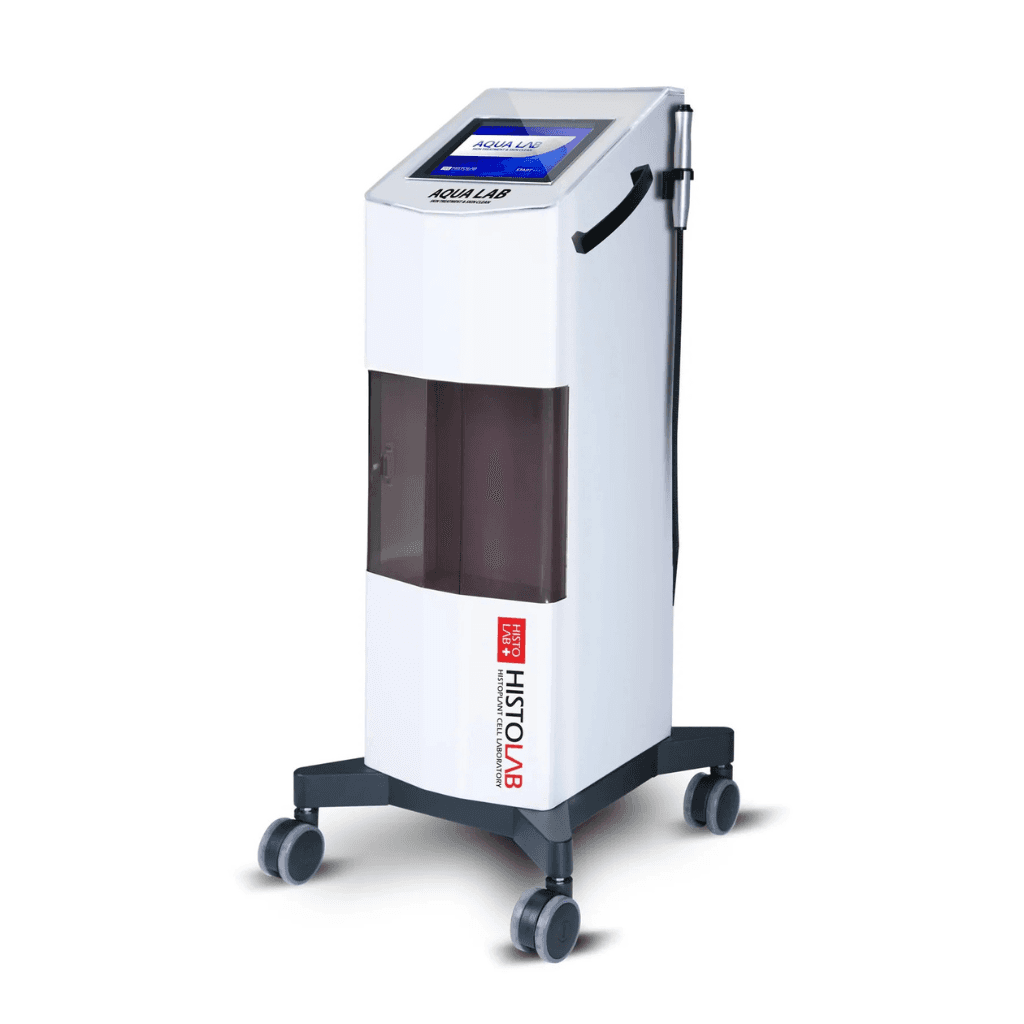
Korea's version of the Hydrafacial. It strips off the dead surface layer, suctions out blackheads, and pushes serum into freshly cleaned skin — done in under an hour.
The ₩30,000 glass skin facial in Myeongdong is Aqua Peel, Korea's version of the Hydrafacial: a vacuum wand that exfoliates dead skin, suctions blackheads, and infuses serum in about 40 minutes. Myeongdong walk-in clinics price the treatment at $25–$55 as a loss leader, versus $70–$150 at Gangnam boutiques. The glow peaks for 7–14 days, so Korean patients typically rebook monthly or before an event.
One-off refresh · monthly for cumulative effect
Myeongdong walk-in: $25–$55. Gangnam boutique: $70–$150. A combined "glass skin package" (Aqua Peel + LDM + Exosome): $120–$250. Multi-session courses bring the per-session price down to roughly $60–$120 across three sessions.
What is actually happening to your skin
Aqua Peel uses a small wand with a vacuum tip that does three things simultaneously: gently exfoliates the top layer of dead skin cells, suctions blackheads from pores, and floods freshly cleaned skin with a liquid serum (typically some combination of salicylic acid, vitamin C, hyaluronic acid, or niacinamide, depending on the tier you choose).
The wand cycles through three or four tips during a typical 40-minute session, each carrying a different serum. The end result is the "glass skin" look: smooth, hydrated, reflective, almost no visible pores in photos.
Where "glass skin" came from
"Glass skin" appeared in Korean beauty magazines around 2017, originally describing the result of a long, multi-step skincare routine — not a single treatment. Aqua Peel, which Korean clinics started offering around 2014–2015, became the shortcut: 40 minutes in a chair instead of weeks of discipline.
By 2019, viral TikTok content had sent the term worldwide. By 2024, Aqua Peel was the single most-booked walk-in procedure in Myeongdong, the tourist-heavy shopping district in central Seoul.
Why ₩30,000 is the "tourist rate"
Neighborhood clinics in Myeongdong and Hongdae run walk-in Aqua Peel for ₩30,000–₩70,000 (about $25–$55) as a loss leader — the clinic makes little on the treatment itself and is betting on converting some walk-ins into longer-term packages like Rejuran or skin boosters. Boutique clinics in Gangnam or Cheongdam charge 2–3× more for longer sessions with premium serums, often re-branded as "Signature Glow" or "Cheongdam Peel."
For a one-off pre-dinner glow, the Myeongdong rate is hard to beat. For a real skin consultation with customized serums, go to the Gangnam tier.
How the serum tiers work
Most menus list three or four tiers. Tier 1 (salicylic acid–based) is the aggressive oil-stripping option — good for oily or acne-prone skin, bad for sensitive or dehydrated skin. Tier 2 (niacinamide plus HA) is the all-purpose default: brightening, hydrating, low-risk — the right pick for most first-timers. Tier 3 (vitamin C plus peptides) is the "anti-aging" option, with mild collagen support. Tier 4 ("premium" or "deluxe") typically finishes with an exosome or growth-factor serum and pushes the price past $100.
For a first visit, Tier 2 is the safe, predictable pick.
What it will not do
Aqua Peel is a surface refresh, not a clinical treatment. It does not lift sagging skin, remove deep pigmentation, or fix acne scars. Done weekly it can help acne-prone skin, but as a single session it works best as a "day-before-photos" maintenance step.
Expecting a permanent change is the most common visitor disappointment. Honest clinics call it "maintenance glow," not "skin transformation."
The 48-hour aftercare routine
After Aqua Peel your skin barrier is briefly more open — it absorbs more easily but also reacts more easily. For the first 48 hours: no retinoids, no AHAs or BHAs, no sauna or jjimjilbang (Korean public bathhouse), SPF 50 outdoors, and no heavy makeup for the first 12 hours.
Most Korean patients apply a hydrating sheet mask the night of the treatment and an exosome or growth-factor serum the next morning — this stretches the peak glow from about 7 days to 10–14 days.
Fun facts & trivia
- The American "Hydrafacial" brand and Korea's "Aqua Peel" use essentially the same technology — vacuum exfoliation plus serum infusion. Hydrafacial holds a family of patents, and Aqua Peel devices get around them with small geometry tweaks. That is why US clinics pay licensing fees and Korean clinics generally do not.
- The single highest-volume Aqua Peel clinic in Korea reportedly runs 200+ sessions a day across multiple rooms — basically a "glass skin factory." Quality varies a lot at that throughput, so reviews are a much better guide than the marketing.
- The "aqua" in Aqua Peel refers to the wet tip used to deliver the serum, not the contents of the serum itself. Dry-tip "peel" machines exist but are considered worse — the liquid contact is what makes the technique different from a simple dermaplane.
Recurring patient feedback
- Korean reviewers love the instant smoothness and tend to rebook monthly. The peak glow only lasts 7–14 days, which lines up neatly with a once-a-month rhythm.
- Many visitors pair Aqua Peel with an LDM-MED facial or exosome finisher in the same visit, sold as a "full glass skin package" for $120–$250.
- Sensitive-skin reviewers warn each other to skip the strongest salicylic acid tier on the first visit. Pick a milder tier and tell the technician about any redness or rosacea history.
- The most-recommended use case in Korean reviews: book Aqua Peel the day before a wedding, interview, or photoshoot. The peak glow lines up with the event.
- A small number of reviewers report mild redness for 6–12 hours after the treatment. This is normal, which is why many Korean patients book Aqua Peel in the afternoon rather than the morning.
Common questions
How much does an Aqua Peel cost in Korea?
A walk-in Aqua Peel at neighborhood clinics in Myeongdong or Hongdae costs ₩30,000–₩70,000, about $25–$55. Boutique clinics in Gangnam or Cheongdam charge $70–$150 for longer sessions with premium serums. A combined glass skin package with LDM and an exosome finisher runs $120–$250, and three-session courses bring the per-session price to roughly $60–$120.
How long does the glass skin facial last?
The peak glow from an Aqua Peel lasts about 7–14 days, which is why Korean reviewers tend to rebook monthly. Applying a hydrating sheet mask the night of treatment and an exosome or growth-factor serum the next morning stretches the glow from about 7 days toward 10–14. Aqua Peel is a surface refresh, not a permanent change.
Is Aqua Peel the same as Hydrafacial?
Aqua Peel and the American Hydrafacial use essentially the same technology: vacuum exfoliation plus serum infusion through a wet tip. Hydrafacial holds a family of patents, and Korean Aqua Peel devices work around them with small geometry tweaks, which is why US clinics pay licensing fees and Korean clinics generally do not.
Want help navigating this?
Our coordinators are registered medical tourism facilitators accredited under the Korea Ministry of Health. We match you to 2–3 vetted Seoul clinics at real local prices — free, within one business day.
Start a free consultation →Researched by our team through practitioner interviews, on-the-ground market intel, official manufacturer and clinic websites, and Korean-language reviews on UNNI and Naver Blog. Paraphrased — not verbatim quotes, not medical advice. Verify protocols with a licensed physician before booking.