
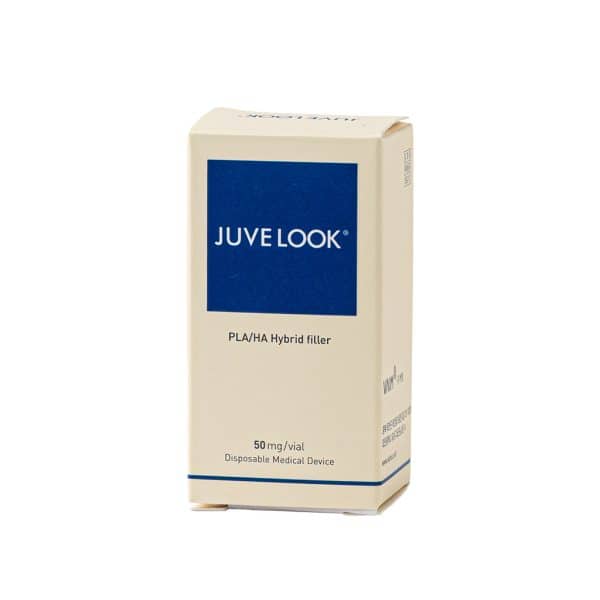
A Korean-made injection that delivers immediate visible hydration plus gradual collagen rebuilding over the following weeks. The booster version of Juvelook (not Volume) is the one Korean injectors increasingly recommend as the next step after Rejuran.
Juvelook is a Korean hybrid skin booster that combines 50 mg PDLLA microspheres with hyaluronic acid: the HA gives same-day hydration and subtle plumping, while the PDLLA dissolves over 8–12 weeks and triggers collagen growth. In Gangnam, Juvelook costs ₩300,000–₩720,000 per vial (≈ $200–$500). A standard course is 2–3 sessions, 4 weeks apart, with maintenance every 6–9 months.
2–3 sessions, 4 weeks apart · maintenance every 6–9 months
₩300,000–₩720,000 per vial in Gangnam (≈ $200–$500). A typical 2–3 session course budgets ₩600,000–₩2,160,000 (≈ $400–$1,500) total, depending on how many vials per session. Bundled with Rejuran in the same visit: most clinics offer a ~10% combined discount. Full cost guide →
What original Juvelook actually does
Juvelook (50 mg PDLLA per vial mixed with hyaluronic acid) is a hybrid skin booster. It is not a volume filler, and it is not a deep volumizer like Juvelook Volume. It works in two phases: the HA gives a same-day hydration and subtle plumping effect you can see in the mirror when you leave, while the PDLLA microspheres dissolve slowly over 8–12 weeks and trigger your own collagen to grow in their place.
The result — better firmness, finer texture, smaller pores, a subtle "lit from within" glow — builds over weeks. This is a skin-quality treatment, not a face-shape treatment. If your concern is hollow cheeks or a softening jawline, you want Juvelook Volume or a structural filler. If your skin looks dull, slightly loose, or older than it should, original Juvelook is one of the strongest single options on Korean menus right now.
Juvelook vs Rejuran — the comparison most patients want
This is the most common comparison in Korean booster consultations. Rejuran uses purified salmon-DNA polynucleotides (PN) to signal skin repair and regeneration — gradual, builds across 3 sessions, produces visible texture smoothing and pore refinement. Original Juvelook uses PDLLA microspheres plus HA — the HA gives a same-day hydration effect Rejuran cannot match, and the PDLLA drives slower collagen build over months.
The honest summary most Korean injectors give: Rejuran for repair and texture, Juvelook for hydration plus subtle firmness. Many patients try both and settle on one. Juvelook tends to win for patients in their late 30s and beyond whose skin "looks deflated" rather than "looks textured."
PDLLA vs PLLA — does the chemistry matter?
Sculptra uses PLLA (poly-L-lactic acid), the classic biostimulator on the market since the early 2000s. Juvelook uses PDLLA (poly-D,L-lactic acid). The "D,L" version dissolves more gradually and triggers less inflammation — which is why Juvelook produces fewer of the surprise lumps that gave Sculptra a reputation for being technically demanding in the 2010s. PDLLA also tolerates higher concentrations without the surface bumps Sculptra can cause when placed too shallow.
The chemistry difference is small on paper but meaningful in practice: most of Sculptra's historical complications simply do not occur with Juvelook at booster-tier dosing.
What a session actually looks like
A session starts with 20–30 minutes of numbing cream. The injector walks a fine needle or small cannula across cheeks, forehead, and chin in a grid, depositing tiny amounts at each point — takes 10–15 minutes. Immediately after, you'll see small bumps at every injection site (like an even grid of mosquito bites). These are visible deposits and settle within 24–48 hours. Most Korean patients plan a "stay-in day" on the day of and the day after.
Bruising at individual sites typically fades within 5–7 days. The same-day glow lands within 24 hours; the collagen build develops over 8–12 weeks. Standard course: 2–3 sessions, 4 weeks apart, then maintenance every 6–9 months.
Who benefits most
Original Juvelook works best for two patient profiles. (1) Mid-30s through 50s patients whose skin has lost bounce and luminosity — mild fine texture and a slightly deflated look that does not yet justify a true filler. The same-day hydration plus 8-week collagen build addresses both concerns in one product. (2) Patients already on Rejuran who want to add a hydration layer their current treatment is missing. Rejuran can leave skin smooth but slightly flat; Juvelook adds subtle plumpness without changing face shape.
Who does not benefit: patients with significant volume loss (they need Juvelook Volume or a structural filler), those with very thin skin where PDLLA microspheres might be visible (rare), and patients who want a fast one-off glow only (Re20 is faster for that purpose).
Things to ask before you sit in the chair
Juvelook protocols vary more than most Korean boosters. Five questions worth asking before you sit down:
(1) How are you diluting it? Standard is lidocaine plus saline. Pure saline is fine. Pure lidocaine is not. (2) Are you injecting Juvelook (booster, 50 mg) or Juvelook Volume (200 mg)? For skin-quality concerns, you want the booster. (3) Can you open the vial in front of me? Counterfeit vials were a real problem in 2024–2025; verification is now standard at reputable clinics. (4) How many sessions are you recommending? A reasonable starter course is 2–3, not 4–5. (5) Will I see the injection bumps, and how long do they last? The correct answer is 24–48 hours. A clinic that says "no bumps" is overpromising.
Fun facts & trivia
- Juvelook is made by VAIM Global, a Korean biotech spun out of a Seoul National University lab in 2018. The original booster launched first; Juvelook Volume followed in 2022.
- The HA component in Juvelook is one of the main reasons most Korean patients prefer it over pure-PLLA Sculptra: the HA gives a same-day visible plumping effect that Sculptra cannot match, while the slower PDLLA collagen build delivers similar long-term volume. The hybrid format is one of the reasons Korean PDLLA-HA biostimulators have largely replaced Sculptra on Gangnam menus.
- Juvelook booster vials have a lighter cap than the darker metallic cap on Juvelook Volume. The two products use the same chemistry but a 4× different dose, so the colour-coded caps exist specifically to prevent injection-room mix-ups.
Recurring patient feedback
- Korean reviews describe original Juvelook as "Rejuran plus a little firmness." People who try both usually keep one and stop stacking long-term.
- The same-day hydration effect is the most-cited positive — patients describe their skin as "fuller and softer" by the next morning, before the collagen build has even started.
- A small group reports initial overfill that calms down in 2–3 weeks. This is a normal phase: the HA component absorbs first while the slower PDLLA effect is still ramping up.
- The injection-point bumps for the first 24–48 hours are the most-mentioned downside. First-time patients sometimes underestimate how visible they are on day 1.
- Foreign reviewers consistently rate Juvelook better value than Rejuran on a per-session basis, but rate the result as more subtle on the first session — the "wow" comes after session 2 or 3, similar to how Rejuran works.
Common questions
How much does Juvelook cost in Korea?
In Gangnam, Juvelook costs ₩300,000–₩720,000 per vial, roughly $200–$500 USD. A typical 2–3 session course budgets ₩600,000–₩2,160,000 (about $400–$1,500) in total, depending on how many vials are used per session. When Juvelook is bundled with Rejuran in the same visit, most clinics offer a combined discount of around 10%.
What is the difference between Juvelook and Rejuran?
Rejuran uses salmon-DNA polynucleotides (PN) to signal skin repair, giving gradual texture smoothing and pore refinement over about three sessions. Juvelook uses PDLLA microspheres plus hyaluronic acid, so Juvelook delivers same-day hydration that Rejuran cannot match, followed by a slower collagen build. Korean injectors typically summarize: Rejuran for repair and texture, Juvelook for hydration plus subtle firmness.
How long does Juvelook take to work?
Juvelook's same-day hydration glow appears within 24 hours of the session, while the PDLLA-driven collagen build develops over 8–12 weeks. Injection-point bumps settle within 24–48 hours and bruising typically fades in 5–7 days. Most Korean reviewers say the noticeable "wow" effect arrives after the second or third session rather than the first.
Want help navigating this?
Our coordinators are registered medical tourism facilitators accredited under the Korea Ministry of Health. We match you to 2–3 vetted Seoul clinics at real local prices — free, within one business day.
Start a free consultation →Researched by our team through practitioner interviews, on-the-ground market intel, official manufacturer and clinic websites, and Korean-language reviews on UNNI and Naver Blog. Paraphrased — not verbatim quotes, not medical advice. Verify protocols with a licensed physician before booking.