
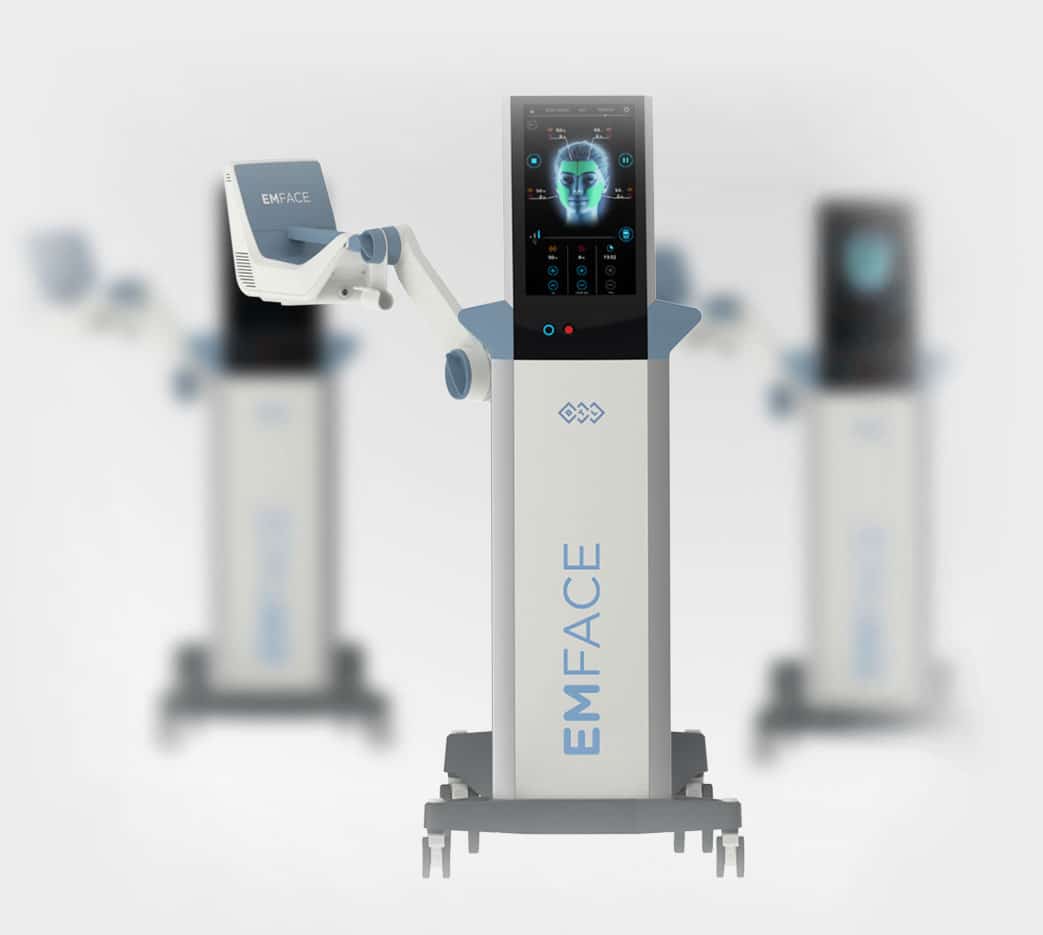
Twenty minutes, no needles. The machine warms your skin while gently exercising the small muscles that hold your face up — and you walk out looking "rested" for weeks.
Emface is a 20-minute, needle-free lifting treatment by BTL that combines RF skin tightening with HIFES electromagnetic pulses that contract the cheek- and brow-lifting muscles. In Korea, a single session costs ₩300,000–₩600,000 (about $220–$450) and a 4-session package ₩1.2M–₩1.8M (about $900–$1,400). The standard course is 4 sessions one week apart, with maintenance every 6–9 months.
4 sessions, 1 week apart · maintenance every 6–9 months
Single session: ₩300,000–₩600,000 (about $220–$450). 4-session package: ₩1.2M–₩1.8M (about $900–$1,400). Most clinics will not sell first-time patients a single session — the 4-session minimum exists because the manufacturer knows that a one-off session almost always disappoints.
What makes Emface different
Emface (made by BTL) does two things simultaneously. It sends RF energy into the lower skin layer to tighten it, while HIFES pulses (high-intensity electromagnetic) contract the cheek-lifting and brow-lifting muscles. Unlike HIFU machines like Ultherapy, no energy goes very deep. Unlike thread lifts, nothing pulls tissue mechanically.
The lift comes from toning the small face muscles that hold your mid-face up — the same way exercise tones body muscles — while RF tightens the skin on top. A session is about 20 minutes, uses four sticky pads, no needles.
How a session feels
Once the pads are on, RF starts as a warm pulse — like a heating pad on your face. Then HIFES kicks in: a rhythmic, obvious twitching in your cheeks. From the outside it looks like an exaggerated involuntary smile held for a fraction of a second, over and over. Korean reviewers call this "cheek push-ups." Not painful, but genuinely strange the first time.
The machine ramps up intensity over the first few minutes as your muscles adjust. You leave with a slightly warm face and no visible change. The actual lift shows up 2–4 weeks after the third session.
Why some Korean clinics call it "M-Face"
Several Korean clinic chains list the same BTL machine as "M-Face" instead of "Emface." Same hardware, same protocol, same software — just a different in-house brand name. If you see "M-Face" priced about 20% lower than "Emface" at the clinic next door, it is almost always the same treatment with a smaller markup.
Korean reviewers have learned to ask which BTL applicator is being used (BTL Emface Classic vs BTL Emface Submental for the chin) rather than which package name the clinic uses.
What to realistically expect
Emface is not a HIFU replacement. It will not fix loose or sagging skin and is nowhere near a facelift. What Koreans actually value it for: a subtle mid-face lift, softer smile lines, and an "awake" appearance that friends notice but cannot quite name.
Jennifer Aniston endorsed it in 2023, sending global demand up sharply. In Korea, patients aged 30–45 mostly use Emface as a 6–9 month maintenance ritual, not a one-time event.
Who should not get Emface
Reputable clinics screen carefully. Contraindications include: Bell's palsy history (HIFES pulses can re-trigger asymmetry even after recovery), a pacemaker or implanted electronic device near the treatment area, filler in cheeks or temples in the past 2 weeks (RF heat can shift the filler), and pregnancy.
A clinic that asks about all of this is doing the right thing. Clinics that skip the screening and just sell you a session are treating Emface like a haircut.
The yearly cost math
A 4-session package is the minimum for real results: about $900–$1,400 for the course, plus maintenance sessions every 6 months at $220–$450 each. First-year total: roughly $1,300–$2,300. After that, upkeep runs $400–$900 per year.
Korean patients who frame Emface as part of "skincare" rather than a special event tend to be the most satisfied — each session treated like a haircut appointment, not a big decision.
Fun facts & trivia
- BTL, the company behind Emface, is the same company that makes Emsculpt — the body-toning HIFEM (high-intensity focused electromagnetic) machine that went viral in 2019. Emface uses a related but facial-specific technology called HIFES. The basic technology is related: making muscles contract at a frequency you cannot match on your own.
- Jennifer Aniston was not an early adopter. She endorsed Emface in 2023, about two years after Korean clinics had already adopted it. Her endorsement pushed global demand way up, but the supply was already in place in Seoul.
- Emface is FDA-cleared to claim improved facial muscle tone and reduced wrinkles, joining a small group of devices (alongside Ultherapy and Sofwave) that have explicit FDA-cleared muscular or lifting indications. That clearance is expensive, which is part of why both treatments are pricey.
Recurring patient feedback
- The most common Korean review pattern: barely visible after session 1, unclear after session 2, "everyone says I look rested" after session 3, and visibly firmer mid-face by session 4.
- First-timers are constantly warned to budget for the full 4-session package up front. A single session feels underwhelming and leads people to wrongly conclude Emface "does not work."
- Pairing Emface with Rejuran in the same month gets the most "wow, this combo works" reviews, especially among Korean patients in their 30s and 40s.
- A small number of reviewers report mild tingling in the cheek for 1–2 days after a session. This is a normal HIFES after-effect, not a complication.
- Reviews from people aged 50+ are more mixed. Emface is great as maintenance at that age, but it cannot replace the deeper lifting tools (Ultherapy, threads) that this group typically needs as well.
Common questions
How much does Emface cost in Korea?
In Korea, a single Emface session costs ₩300,000–₩600,000 (about $220–$450 USD), and a 4-session package runs ₩1.2M–₩1.8M (about $900–$1,400). Most clinics will not sell first-time patients a single session, because a one-off almost always disappoints. Including maintenance every 6 months, the first-year total is roughly $1,300–$2,300, then $400–$900 per year.
Does Emface actually work?
Emface delivers a subtle mid-face lift, softer smile lines, and an "awake" appearance rather than a facelift-level change. The lift typically shows up 2–4 weeks after the third session, and Korean reviewers describe a visibly firmer mid-face by session 4. Emface will not fix loose or sagging skin and does not replace HIFU devices like Ultherapy or thread lifts.
How many Emface sessions do I need?
The standard Emface course is 4 sessions spaced one week apart, followed by maintenance every 6–9 months. Korean reviewers consistently report barely visible change after session 1, unclear results after session 2, and "everyone says I look rested" after session 3, which is why clinics advise budgeting for the full 4-session package up front.
Want help navigating this?
Our coordinators are registered medical tourism facilitators accredited under the Korea Ministry of Health. We match you to 2–3 vetted Seoul clinics at real local prices — free, within one business day.
Start a free consultation →Researched by our team through practitioner interviews, on-the-ground market intel, official manufacturer and clinic websites, and Korean-language reviews on UNNI and Naver Blog. Paraphrased — not verbatim quotes, not medical advice. Verify protocols with a licensed physician before booking.